Water home
     
Capturing India's water story
By Linn T Mostad    
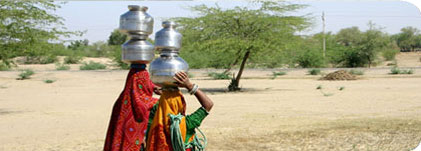
Once upon a time the world was rich with water. Now we are facing an increasing global water crisis. What has gone wrong? It is a puzzle: while the rich part of the world is trying to find water on other planets, because water is a proof of life, the poor part of the world is desperately trying to find water on their own planet to survive. We are told that there is no water scarcity, but why do millions of people have too little water to survive on? Most importantly: how can we find sustainable solutions that assure a water-safe future for the next generations?
Photos: Astrid J Svensson


So far we have only been addressing and fixing the symptoms, but the problem is growing. Today India is extracting more groundwater than it is recharging. At the same time precious water sources are being polluted. In Delhi, it is estimated that groundwater will be over within approximately 10 years. Water management today is through centralized systems. These systems are inefficient and highly polluting. Water is managed through pipe systems, but over 60 percent is lost during distribution. Can technological solutions and the state be trusted to solve the problem? Don't we need to focus on the causes?

We need to think differently. How did India manage water before?

India’s pre-colonial history tells us that neither the state nor the king provided water for the people, but they still had water. They were practicing rainwater harvesting. The basic idea was to construct different systems to harvest the rain, adjusted to the natural environment. By using simple technology they were able to capture and conserve rainwater, and recharge the groundwater.

But this was not a technology-led movement -- local management and community participation were most important factors. Everybody in the village had to contribute, either through work or money. The 'village council' made sure that this was efficient; those who did not contribute were penalized.

      watch slide show
     

British rule invested in centralized water management systems in India. In post-Independent India, the government has set up a plan that assures drinking water to all villages, but each year the number of villages in need of water increases. This clearly shows that the way India and many other nations are managing water today is unsustainable. Due to the size of the country and its immense population, the state is incapable of neither providing, nor managing water for everyone.

In some villages in India, people have revived ancient technologies and are taking collective responsibility to manage their water. By giving the community rights to govern, they can manage their livelihoods more effectively than the state is now capable of doing.

This method has a huge potential: collecting water from 3-4 percent of India’s land area can provide 100 litres of water to 1 billon people. This is not only a solution for India, but for all nations faced with water shortage. The poor world has a great opportunity to manage water in a more sustainable way than the western countries have done. In that way you could say that “poverty” is the biggest opportunity.


   watch slide show