If it is so that poverty is the biggest polluter, can we blame the poor and the uneducated? Are they even aware of what they are possibly causing?
Environmental Education
Earlier, environmental issues were not in the limelight, a place they are finally getting after many years with growing concern. The Centre for Science and Environment (CSE) has brought attention to the growing environmental problems in India. Today CSE has its own environmental education unit, working mainly with creating awareness, providing materials and schooling in the Green Schools Programme. They also provide a Green Schools manual that gives teachers an idea on how to educate their students about environmental issues and how to implement sustainable use of resources at their own school. CSEs Gobar Times, which is the monthly Down to Earth supplement, makes complicated issues available to the younger generations. Gobar Times also has an annual Green Schools Award.
Another institution is the Centre for Environmental Education (CEE), that focuses on developing, coordinating and conducting a number of educational programmes for school children. In India environmental education is being taught in most schools up until the 9th grade. Today the programmes reach out to over 3000 schools across the country. CEE simultaneously work with creating awareness and involving youth in formal and informal environmental improvement action projects. The main task of all environmental education is to introduce children and adults to the beauty and harmony of nature, and in the process sensitize them to the need for concern and conservation of the environment.
Awareness is growing
In India, schools, media and the government are taking more interest in environmental issues. When asking randomly chosen people on the streets of Delhi, most people know about the problems affecting both India and the rest of the world today. On the other hand, they do not agree on how to meet the challenges, and especially on who is to blame. All of the interviewees consider education and broader knowledge as contributors to change, and the average Indian is of the opinion that environmental awareness is a continuation of general education. Therefore many see the challenge not only being an increase in environmental knowledge, but a general improvement of the overall education level. The young people we meet confirm that they have had environmental education at a primary level, but the older generation shows little interest and awareness towards the challenges. According to the urbanised, young, educated and westernised Indians, the poor do not share their concern for the environment. The proposed reason for this is that they do not know the difference between good and bad air or water. Their only concern is to cover basic needs for survival. Is this claim true?
The poor and uneducated
The majority of the population in India lives in rural areas and have little or no schooling. If it is so that education and environmental action is interlinked, will they be able to cope with the environmental challenges? What we have observed is that even if they do not have environmental education or awareness created through media and other channels, they are connected to nature in a different manner. Their approach to the environment around them is resiprocal. Their entire livelihood often depends on the way they manage their natural resources. The poor in rural areas interact with nature in ways that is far from what is generally observed in urban areas. But the poor have few resources compared to the urbanised and rich. Therefore the possibilities of choosing the most sustainable solution is not always within reach. The poor are not concerned and affected by environmental problems outside their area and are seldom aware of the global challenges. On the other hand, they can hardly be blamed for them either.
Responsible for environmental action and sustainable use of resources
To be able to see that human action has consequences for our environment is more a human attribute, than a taught feeling. According to Rajendra Singh, the Chairman of the NGO Tarun Bharat Sangh, the natural cycle of life and death in nature is imprinted in every Indian's psyche. Yet many Indians lack guidance and stronger government intervention as they see their rivers getting darker, garbage not being handled properly and air pollution increasing, especially in the cities. Weak law enforcement makes people careless, but it should not only be the threat of punishment that make people think twice about their actions. It should be a sense of responsibility and awareness about environmental consequences.
Placing environmental education on the agenda and making it attractive, confirms the importance of making people see how human interference affect nature. By implementing environmental and developmental terms in daily life, awareness can be raised. Education is needed in both urban and rural areas. The urban population can learn from knowledge and sustainable use of natural resources that tribes and indigenous people practice today.
It is difficult to make people responsible for hazardous actions when they do not know that their behaviour is destructive. Therefore, awareness and education about environment is crucial to enforce ethical and sustainable use of nature in the future. Education can be a motivator and an inspiration for young people. Children can meet people that are making a difference and this can motivate them into positive actions. Familiarizing people with nature, make them responsible for their actions and being aware of their behavior, will be a step in the right direction. It is not a question; The worst polluters are the educated, because they know what they are doing.
|
 |
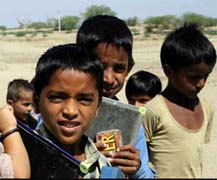
 watch slide show watch slide show
"Environmental literature being generated for school children is, with some exceptions, in the genre of nature education. It is very important to expose young children to the beauties and wonders of nature. But as they grow older, it is important they begin to understand how human beings and human societies interact with their environment for their survival and their growth, how these human interactions become a part of a society's culture, and why it is important to rationalise our relationship with our environment."
Anil Agarwal
founder-director of CSE |
|