| Which
value does the forest
have for you? |
| For
Indians it has a lot of
value; special,
economical, cultural,
ecological and
historical. We are a
society that believes in
conservation of the
forest. Animals and
plants have always been
respected and even
worshiped. Many people
depend on the forest. |
| |
| What
do you think is the best
way to protect and
manage the forest? |
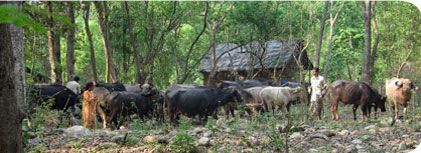
| Considering
the circumstances, the forest is in a fairly good condition.
People are associated
with forest, and they
depend on the forest.
Therefore the forest is
under a lot of pressure,
from grazing of animals
and the gathering of
fodder and fuel wood.
The biotic pressure is
the biggest threat to
Indian forests today. |
 |
|
What about industry
as a threat?
|
There
is no large
scale industry that operates in
Indian forests today.
The growth of industry
is happening outside the
forests.
Should everybody have
the right to use the
forest as they please? |
|
Photo: Ragnhild
Vognild
|
| In an ideal situation,
yes, but the reality is
different. If it was an
open resource, then
everyone would like to
use it, and it could
easily be degraded.
There are too many
people on too little
land in India today. The
main priority
should be to meet the
villagers requirements. |
| |
| ...then who should
decide how people could
use the forest? |
| The
Forest Department is
satisfied with owning
the forest land in India
today, which covers 25 per cent
of the country. But it
is important to involve
the locals in the
process of management.
The Ministry of
Environment and Forest
has changed its practice since the 1990s.
From being more or less
a forest police it now aims to involve and
cooperate with the
locals. This practice is
called Joint Forest
Management. The locals
are the most important
stakeholders. The
government is in charge.
Not every
village does it equally
well and need education
and handholding from us
to learn how to make
sustainable use of the
forest. Some people are
so poor that they only
bother about their next
meal; this can lead to
exploitation of the
forests. Many villagers
do not understand and
have no option but to
ignore, the accumulating
effect of this kind of
use. I do not mean that
one should stop taking
things out of the
forest, but it is
important that locals
get the biggest benefit.
The best would be if the
Forest Department and
the villagers could work
together, both to manage
the forest and to make
villagers’ lives better. |
| |
| |